
There are certain emails that stay with you.
Most days, my inbox looks exactly how you’d expect. Class registrations. Scheduling requests. Questions about certification renewals. Businesses trying to coordinate training around multiple shifts and busy production schedules.
Then there are the emails that make you stop scrolling.
The ones that remind you exactly why you do what you do.
A few weeks ago, I received an email from an industrial workplace here in Upper Michigan where I had recently taught a CPR and First Aid class.
The message wasn’t long.
It simply explained that one of their employees had successfully helped a choking victim.
The cause?
Broccoli.
Not a dramatic workplace accident.
Not a massive emergency requiring helicopters and flashing lights.
Just lunch.
One moment, an employee was eating. The next, they couldn’t breathe.
Thankfully, another employee immediately recognized the signs of choking and stepped in. Instead of freezing, panicking, or waiting for someone else to act, they used the choking rescue skills they had learned during training.
The obstruction was cleared.
The employee recovered.
Everyone went home.
And because someone knew what to do, what could have become a tragedy became a story.
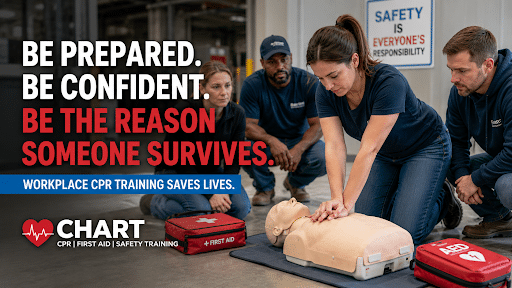
That email was a reminder that workplace CPR training isn’t just another safety requirement. It’s preparation for moments nobody expects.
If you’re looking for a workplace CPR course in UP Michigan, CHART offers in-person training, blended online options with in-person skills sessions, and customized workplace safety programs for organizations of all sizes.
Learn more about our workplace CPR and safety training programs for Upper Michigan businesses.
The Emergency Nobody Sees Coming
Most people think emergencies happen somewhere else.
To someone else.
On another day.
Maybe after some giant warning sign appears.
But real emergencies don’t work that way.
One minute you’re sharing lunch with coworkers.
The next minute someone can’t breathe.
One minute you’re discussing production goals.
The next minute a team member collapses.
One minute you’re wishing a meeting had been an email.
The next minute you’re witnessing a medical emergency.
Emergencies don’t schedule themselves around convenient times.
They don’t check calendars.
They don’t care whether someone nearby feels prepared.
And that’s exactly why workplace CPR training matters.
Why Workplace CPR Training Matters More Than Most Businesses Realize
Many employers think of CPR training as something they should probably do someday.
Something that would be nice to have.
Something that belongs on a compliance checklist.
But the reality is much bigger than that.
According to the American Heart Association, more than 350,000 out-of-hospital cardiac arrests occur each year in the United States. Immediate CPR can double or even triple a person’s chance of survival.
Think about that for a moment.
Double.
Or triple.
That’s not a small improvement.
That’s the difference between a family getting another holiday together or not.
That’s the difference between someone walking back into work next month or never returning.
When cardiac arrest occurs, the first few minutes are critical.
EMS professionals are incredible.
Emergency departments are incredible.
But neither can travel backward in time.
The people already present become the first link in the chain of survival.
The Bystander Effect Is More Common Than You Think
Here’s something fascinating—and honestly a little uncomfortable.
Researchers have spent decades studying how people react during emergencies.
What they’ve discovered is that people often assume someone else will help.
Someone more qualified.
Someone older.
Someone smarter.
Someone with medical experience.
Everyone looks around.
Everyone waits.
And valuable seconds pass.
The employee who helped the choking victim didn’t wait.
They didn’t wonder whether someone else should step in.
They acted.
And they acted because training removes hesitation.
Training gives your brain a roadmap.
Without training, fear often fills the gap.
Why CPR Training Matters Even More in Upper Michigan
Living and working in the Upper Peninsula comes with a lot of advantages.
Beautiful scenery.
Strong communities.
A slower pace of life.
People who genuinely look out for one another.
But we also have something many urban areas don’t.
Distance.
Whether you’re located in Marquette, Escanaba, Iron Mountain, Houghton, Sault Ste. Marie, Ironwood, or a smaller UP community, emergency response times can vary based on weather, geography, staffing, and travel distances.
When cardiac arrest occurs, every minute matters.
The American Heart Association notes that survival decreases significantly when CPR isn’t started quickly.
In many situations, workplace employees aren’t simply witnesses.
They’re the bridge between the emergency and professional medical care.
What Most Employees Say Before Class
After teaching thousands of students over the years, I’ve noticed a pattern.
Before class starts, people often say things like:
“I don’t think I could do CPR.”
“I’d probably panic.”
“I don’t want to hurt someone.”
“I’d just call 911.”
Those thoughts are completely normal.
In fact, they’re incredibly common.
But something interesting happens during class.
People begin practicing.
They start building muscle memory.
They gain confidence.
And by the end of the course, many of those same students leave thinking:
“Okay. I can do this.”
That’s the goal.
Not fearlessness.
Preparedness.
There’s a big difference.
The Skill That Goes Home With You
One of my favorite things about workplace CPR courses is that the benefits don’t stay at work.
Employees take those skills home.
To family dinners.
To sporting events.
To church functions.
To restaurants.
To community gatherings.
To everyday life.
According to the American Heart Association, nearly 70% of out-of-hospital cardiac arrests happen at home.
That means the person most likely to need CPR from you may not be a stranger.
It may be your spouse.
Your parent.
Your child.
Your best friend.
That’s what makes CPR training so powerful.
The certification card belongs to your employer.
The skills belong to you forever.
Why Hands-On Training Still Matters
We live in a world where almost anything can be learned online.
Need to fix a faucet?
There’s a video for that.
Need to bake sourdough bread?
There are about 5,000 videos for that.
Need to learn CPR?
There are videos for that too.
In fact, I’ve created educational CPR and emergency response videos on the CHART YouTube channel because I believe everyone should have access to life-saving information before they ever walk into a classroom.
But here’s the reality.
CPR is different.
Because CPR isn’t information.
It’s a skill.
And skills live in your hands.
You can watch someone perform CPR a hundred times.
That doesn’t teach your muscles how hard to compress a chest.
It doesn’t teach proper hand placement.
It doesn’t teach rhythm.
It doesn’t teach confidence.
Hands-on practice does.
That’s why instructor-led training remains such an important part of CPR certification.
Experience creates confidence.
And confidence is what shows up during an emergency.
Building a Stronger Safety Culture
One of the unexpected benefits of workplace CPR training is what it communicates to your team.
When employers invest in safety, employees notice.
Customers notice.
Visitors notice.
It sends a simple but powerful message:
“We care enough to prepare.”
Safety isn’t created by policies hanging on a wall.
Safety is created by people.
Prepared people.
Confident people.
People who know what to do when things suddenly go sideways.
The Cost of Not Being Prepared
Here’s a question worth considering.
What would it cost your organization if an emergency happened tomorrow?
Not financially.
Emotionally.
What would it feel like to know someone needed help and nobody knew how to provide it?
The employee who helped the choking victim wasn’t extraordinary.
They weren’t a paramedic.
They weren’t a nurse.
They weren’t a superhero.
They were trained.
That’s it.
Training transformed an ordinary employee into someone capable of making an extraordinary difference.
In-Person and Online Workplace CPR Courses Through CHART
Every organization has different training needs.
Some businesses prefer traditional hands-on instruction delivered directly at their workplace.
Others need flexible options that work around shift schedules, staffing challenges, and operational demands.
CHART offers both.
Our training options include:
- Traditional in-person workplace CPR training
- Flexible online coursework paired with an in-person skills session
- Group training opportunities
- Customized workplace safety education
- CPR, AED, and First Aid certification programs
This blended learning approach allows employees to complete portions of their training online while still demonstrating hands-on skills with an instructor.
The result is greater flexibility without sacrificing competency or confidence.
Whether you’re training a small office, a manufacturing facility, a school staff, a church group, or an entire workforce, we can help create a solution that fits your needs.
Our goal isn’t simply certification.
It’s confidence.
Because certification cards are nice.
But confidence is what shows up during an emergency.
The Email I’ll Never Forget
I still think about that email.
Not because broccoli is particularly dangerous.
Although it certainly earned a reputation that day.
I think about it because it perfectly captures why workplace CPR and First Aid training matter.
Nobody expected that emergency.
Nobody planned for it.
Nobody walked into work that morning expecting to save a life.
Yet there they were.
One person needing help.
Another person prepared to give it.
That’s what workplace CPR training creates.
Preparedness.
Confidence.
Capability.
And sometimes, a story with a happy ending.
If you’re looking for a workplace CPR course in UP Michigan, now is the perfect time to invest in your team.
Because emergencies don’t wait for training.
But training can make all the difference when emergencies happen.
Explore our in-person and blended workplace CPR training programs to find the right solution for your team.
You may also enjoy reading: Can You Do CPR Without Certification?
Frequently Asked Questions About Workplace CPR Courses in UP Michigan
How long does a workplace CPR course take?
Most workplace CPR certification courses can be completed in a few hours, depending on whether First Aid and AED training are included.
Can CHART provide CPR training at our workplace?
Yes. CHART offers on-site workplace CPR training throughout Upper Michigan, allowing businesses to train employees without disrupting operations.
Do you offer online CPR courses?
Yes. CHART offers flexible online learning options paired with an in-person skills session for those who need scheduling flexibility while still meeting certification requirements.
How often does CPR certification need to be renewed?
Most CPR certifications are valid for two years, although specific employer or industry requirements may vary.
What industries benefit most from workplace CPR training?
Manufacturing facilities, schools, childcare centers, churches, municipalities, retail businesses, construction companies, hospitality organizations, and office environments can all benefit from CPR and First Aid training.
Is CPR training required by OSHA?
OSHA requirements vary by industry and workplace risk level. While CPR certification is not universally required, many organizations include CPR training as part of their workplace safety initiatives.
Can CPR really save a life?
Absolutely. According to the American Heart Association, immediate CPR can double or even triple a victim’s chance of survival when performed before EMS arrives.