
Nobody wakes up on a Tuesday morning thinking:
“You know what might happen today? A cardiac emergency in the cereal aisle.”
And yet… cardiac arrest happens every single day in completely ordinary places.
At soccer games.
At birthday parties.
At gyms.
At work.
At family dinners where somebody is arguing about potato salad for reasons nobody fully understands.
Which is exactly why so many people Google this question:
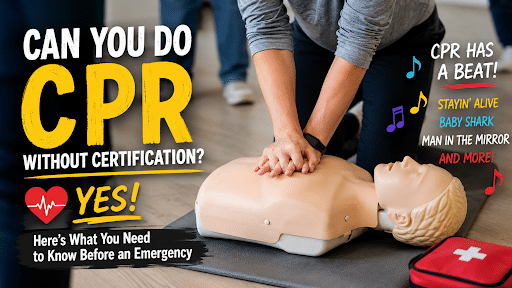
Can you do CPR without certification?
And the answer is:
Yes. Absolutely.
If someone collapses in front of you, you do not need a CPR certification card in your wallet to help save their life.
911 dispatchers can walk people through compression-only CPR over the phone. There are online CPR videos that can help people understand the basics. And doing something is almost always better than standing there frozen while waiting for EMS to arrive.
But — and this is the part people don’t fully realize until they take a class — there’s a massive difference between:
- hearing CPR instructions during a panic
- watching a quick video online
- and physically practicing CPR enough that your body knows what to do under pressure
That difference matters more than most people think.
Because CPR isn’t trivia.
It’s muscle memory.
Yes, You Can Perform CPR Without Certification
A lot of people assume CPR is legally restricted to nurses, paramedics, firefighters, or healthcare professionals.
Not true.
Good Samaritan laws generally protect people who provide emergency care in good faith during emergencies. If someone goes into cardiac arrest in front of you, nobody is expecting you to pause and present a laminated certification card before helping.
And honestly? Emergency responders would much rather arrive to find someone attempted CPR than find a room full of people too afraid to act.
According to the American Heart Association:
- more than 350,000 out-of-hospital cardiac arrests happen in the United States every year
- nearly 70–80% happen at home
- immediate CPR can double or even triple survival chances
That last part is huge.
Because most cardiac arrests don’t happen in hospitals where a whole medical team magically appears three seconds later like a TV drama.
They happen around regular people.
Parents.
Coworkers.
Teachers.
Coaches.
Teenagers.
Grandparents.
Neighbors.
People who suddenly realize:
“Oh no. I’m the adult in this situation.”
Dispatchers Can Talk You Through Compression-Only CPR
If someone is unresponsive and not breathing normally, 911 dispatchers can often coach bystanders through compression-only CPR until EMS arrives.
Compression-only CPR focuses on:
- hard, fast chest compressions
- maintaining blood circulation
- keeping oxygen moving through the body
And yes — dispatcher-assisted CPR absolutely saves lives.
This is one reason emergency responders encourage people not to panic if they’re untrained. The dispatcher can help guide you through the process in real time.
But let’s be honest for a second.
Trying to learn CPR for the first time while someone is actively unconscious in front of you is… not exactly the ideal learning environment.
That’s like trying to learn how to parallel park while actively blocking traffic and sweating through your hoodie.
Helpful? Sure.
Stressful? EXTREMELY.
Watching CPR Videos Online Helps — But It’s Still Not the Same as Training
We live in a world where people learn everything online now.
Recipes.
Home repairs.
Dance trends.
How to fold fitted sheets (still suspicious).
And yes — CPR.
Watching CPR videos is genuinely helpful. Exposure matters. Familiarity matters. Seeing the process beforehand matters.
But CPR is a physical skill.
And physical skills don’t fully live in your brain.
They live in your hands.
Most people are shocked the first time they practice CPR on a manikin because:
- compressions require more force than expected
- rhythm is harder to maintain under pressure
- people hesitate because they’re afraid of doing harm
- panic makes everything feel harder
That’s why hands-on CPR training changes people.
You’re not just memorizing steps.
You’re practicing:
- compression depth
- compression rhythm
- hand placement
- AED use
- scene assessment
- recognizing cardiac arrest
- how to respond when adrenaline kicks in
And honestly? That confidence matters.
Because emergencies are already chaotic enough without your brain trying to run Windows 95 in panic mode.
The Weirdly Important Part: CPR Has a Beat
One of the biggest challenges during CPR is maintaining proper compression rhythm.
Current guidelines recommend compressions at around 100–120 beats per minute.
Which sounds very technical and medical until someone says:
“Basically… compress to the beat of Stayin’ Alive.”
And suddenly everybody understands.
Some popular CPR rhythm songs include:
- Stayin’ Alive — Bee Gees
- Baby Shark — yes, somehow this became medically useful
- Man in the Mirror — Michael Jackson
- Crazy in Love — Beyoncé
- Just Dance — Lady Gaga
- Dancing Queen — ABBA
And yes… people absolutely remember this stuff better because of the music.
Honestly, if Baby Shark ends up helping someone maintain proper compression rhythm during an emergency, then those tiny animated sharks have officially contributed to public health.
We may not like it.
But we respect it.
Here’s the Part Most People Don’t Realize About CPR
Knowing CPR intellectually and performing CPR during a real emergency are two completely different experiences.
Because emergencies don’t happen in calm environments.
They happen while:
- someone is screaming
- family members are panicking
- your own adrenaline is surging
- your hands are shaking
- and your brain is trying to process what’s happening in real time
That’s why CPR certification matters.
Not because it gives you permission to help.
Because it gives you practice before the pressure arrives.
Training helps people:
- recognize emergencies faster
- start CPR sooner
- maintain better compression quality
- feel less helpless
- and respond with more confidence
And that confidence can absolutely impact outcomes.
Bystander CPR Saves Lives — Literally
This isn’t motivational poster language.
It’s measurable reality.
According to research from the American Heart Association and the CDC:
- survival decreases by approximately 7–10% for every minute without CPR or defibrillation
- brain damage can begin within 4–6 minutes without oxygen
- bystander CPR significantly improves survival rates
In many communities, EMS response times average longer than the critical early window.
Meaning the person standing nearby often becomes the bridge between collapse and survival.
And here’s the powerful part:
Bystander CPR doesn’t need to come from medical professionals.
It comes from ordinary people who decided to learn a life skill before they needed it.
Learning CPR Doesn’t Make You a Hero
This is important.
CPR certification is not about becoming some dramatic action-movie rescuer.
It’s about reducing helplessness.
It’s about knowing that if:
- your child chokes
- your spouse collapses
- your coworker goes down at work
- someone has a medical emergency at the gym
- or a stranger collapses in a grocery store
…you won’t have to stand there completely frozen.
You’ll know what to look for.
You’ll know where to start.
You’ll know how to help until EMS arrives.
And honestly? That’s one of the most practical skills a person can carry through life.
If You Learn Better by Watching, I’ve Got You Covered
Sometimes reading about CPR only goes so far.
That’s why I also create CPR videos, skits, and educational content designed to make learning memorable, approachable, and a little less intimidating.
Because honestly?
People remember things better when they’re not being talked to like a medical textbook.
You can check out some of my CPR content here:
- YouTube CPR Shorts: CPR Skits
- TikTok CPR Videos: CPR Skits and Education
Whether you’re brand new to CPR or just need a refresher, sometimes seeing real demonstrations (and laughing a little along the way) helps the information actually stick.
So… Should You Take a CPR Class?
If you’re asking me personally?
Yes.
Not because you legally have to.
Not because you’re trying to become a healthcare worker.
Not because emergencies are guaranteed.
But because life is unpredictable.
And CPR is one of those rare skills that quietly follows you everywhere:
- your home
- your workplace
- your family gatherings
- your kids’ sporting events
- your community
You hope you never need it.
But if you do?
You’ll be really glad your hands already know what to do.
If you’d like hands-on CPR, AED, or first aid training for yourself, your workplace, your childcare center, or your group, you can learn more here:
CHART classes
Frequently Asked Questions
Can you legally perform CPR without certification?
Yes. Good Samaritan laws generally protect people who provide emergency care in good faith during emergencies.
Can a dispatcher teach CPR over the phone?
Yes. Emergency dispatchers can coach callers through compression-only CPR until EMS arrives.
Is compression-only CPR effective?
Yes. Compression-only CPR can significantly improve survival outcomes during adult sudden cardiac arrest.
Does CPR training improve outcomes?
Yes. Studies consistently show that early bystander CPR improves survival rates and neurological outcomes.
Is online CPR training enough?
Online videos are helpful for awareness and familiarization, but hands-on training provides physical practice and confidence that videos alone cannot fully replicate.