
There are certain things no parent wants to imagine.
You baby-proof the cabinets. You check the car seat straps twice. You cut food into tiny pieces, move suspiciously quiet toddlers into your direct line of sight, and somehow develop the ability to hear a cough from three rooms away.
But knowing how to do CPR on a baby?
That’s one of those things many parents know they should learn… right after finishing the laundry, scheduling the dentist appointment, finding the missing sippy cup, and handling the other 847 things currently living in their brains.
Here’s the answer you need to know: If a baby is unresponsive and not breathing normally or is only gasping, CPR involves recognizing the emergency, getting help, performing repeated cycles of chest compressions and rescue breaths, and using an AED as soon as one is available.
The steps sound straightforward when you read them.
Performing them correctly, under pressure, when the baby in front of you is someone you love?
That’s why hands-on training matters.
Knowing the basics of infant CPR can help you understand what to do in an emergency. Practicing those skills in a formal pediatric CPR class can help turn that information into something much more valuable: the ability to act.
When Should You Perform CPR on a Baby?
Infant CPR is used when a baby is unresponsive and is not breathing normally or is only gasping.
For CPR purposes, an infant is generally a child younger than one year old.
If you think something is wrong, start by checking whether the scene is safe. Then check the baby for responsiveness and normal breathing.
If the baby is unresponsive and not breathing normally or is only gasping, the situation is an emergency.
Get help, activate emergency medical services, and begin CPR according to your level of training.
Here’s the part parents need to understand: You do not want your first introduction to these steps to happen while you’re terrified, your hands are shaking, and someone is calling 911.
Reading about CPR is useful.
Watching someone demonstrate CPR is useful.
Actually practicing CPR with an instructor who can correct your technique is where information starts becoming a physical skill.
And CPR is absolutely a physical skill.
How to Do CPR on a Baby Step by Step
Current pediatric CPR guidance emphasizes immediate action when an infant is unresponsive and not breathing normally or is only gasping.
Here is a basic overview of how infant CPR works.
Step 1: Make Sure the Scene Is Safe
Before approaching the baby, quickly check your surroundings.
Is there traffic?
Fire?
Electrical danger?
Water?
Anything else that could put you or the baby in additional danger?
You cannot help effectively if you become injured too, so take a quick look before moving in.
Step 2: Check the Baby for Responsiveness and Breathing
Check whether the baby responds and look for normal breathing.
If the baby is unresponsive and is not breathing normally or is only gasping, CPR is needed.
Shout for help and make sure emergency medical services are activated.
If another person is nearby, give clear directions. Instead of yelling, “Somebody call 911!” point to a specific person and tell them to call 911 and get an AED if one is available.
Why?
Because “somebody” has a remarkable ability to turn into “everybody thought somebody else was doing it.”
Emergencies are not the time for vague group projects.
Step 3: Position the Baby on a Firm, Flat Surface
Place the baby on their back on a firm, flat surface whenever possible.
You need a stable surface underneath the baby so your chest compressions can be performed effectively.
A soft bed, couch, or cushion can absorb some of the force needed for compressions.
Step 4: Begin Chest Compressions
Position yourself so you can deliver chest compressions in the center of the baby’s chest.
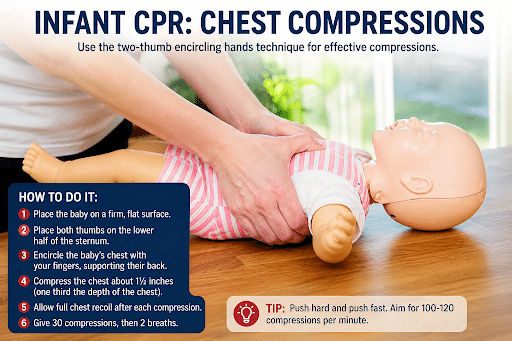
Current 2025 American Heart Association and American Academy of Pediatrics guidance recommends the one-hand technique or the two-thumb encircling-hands technique for infant chest compressions. If you cannot physically encircle the infant’s chest, the heel of one hand may be used.
Compress the chest approximately one-third of its depth, or about 1½ inches (4 centimeters).
Allow the chest to return fully to its normal position after each compression.
For a single rescuer, perform 30 chest compressions followed by 2 rescue breaths.
Aim for a compression rate of 100 to 120 compressions per minute.
That may sound like a lot to remember.
Hand position.
Depth.
Rate.
Recoil.
Counting.
Breaths.
Calling for help.
Keeping your own brain from leaving the building entirely.
This is exactly why CPR training involves practice.
You are not simply memorizing instructions. You are teaching your hands and body how to perform a skill.
Step 5: Give 2 Rescue Breaths
After 30 compressions, open the baby’s airway according to your CPR training.
Create a seal over the baby’s mouth and nose and give 2 rescue breaths.
Each breath should be delivered over about one second and should make the chest visibly rise.
Avoid giving breaths too quickly or forcefully.
Babies are small. Their lungs are small. More air is not automatically better.
If the chest does not rise, reposition the airway and try again.
Then immediately return to chest compressions.
Step 6: Continue Cycles of 30 Compressions and 2 Breaths
Continue performing cycles of:
30 chest compressions
followed by
2 rescue breaths
Keep going until:
- The baby shows signs of life.
- An AED is ready to use.
- Emergency medical professionals arrive and take over.
- The scene becomes unsafe.
- You are physically unable to continue.
Infant cardiac arrest often has a respiratory cause, which is one reason rescue breaths are an important part of pediatric CPR.
Watch: How to Perform CPR on an Infant
Sometimes it helps to see the steps instead of trying to picture them from words alone.
CHART has created a video demonstration showing the basic steps of infant CPR.
Watch the CHART infant CPR demonstration video here.
The video can help you become more familiar with the process and reinforce what you learn during formal training.
But—and this is an important but—watching someone else perform CPR is not the same thing as practicing it yourself.
You can watch someone parallel park 46 times and still end up three feet from the curb when it’s your turn.
Physical skills require physical practice.
CPR is no different.
Can You Use an AED on a Baby?
Yes. An AED, or automated external defibrillator, can be used during an infant cardiac emergency.
If an AED becomes available, turn it on and follow its prompts.
Use pediatric pads or a pediatric setting when available and appropriate. If pediatric equipment is not available, follow the instructions provided by the AED and your CPR training.
Make sure no one is touching the baby while the AED analyzes the heart rhythm or delivers a shock.
After the AED delivers a shock—or tells you that no shock is advised—immediately resume CPR, beginning with chest compressions.
An AED is designed to guide rescuers through the process with visual and/or spoken instructions.
Still, there is a significant difference between seeing an AED mounted on a wall and actually having practiced using one.
That’s another reason quality CPR training matters.
What Is the Difference Between Infant CPR and Adult CPR?
One of the biggest mistakes people make is assuming CPR is exactly the same for everyone.
It isn’t.
The basic purpose remains the same: maintain blood flow and oxygen delivery until more advanced medical care becomes available.
But infant CPR requires age-appropriate techniques.
Babies have smaller bodies, smaller airways, and different physical needs than adults.
Compression techniques are different.
Compression depth is different.
Rescue breaths must be delivered appropriately for the baby’s size.
The way an emergency unfolds may also be different.
In adults, sudden cardiac arrest is often associated with a heart-related problem. In infants and children, cardiac arrest more commonly develops after a breathing emergency.
That is why learning pediatric CPR specifically is so important for parents, grandparents, babysitters, childcare providers, teachers, and anyone else responsible for young children.
Knowing adult CPR is valuable.
Knowing how to respond to an infant emergency is a different skill set.
What If the Baby Is Choking?
Choking and cardiac arrest are different emergencies, although severe choking can eventually cause a baby to become unresponsive.
If a baby is conscious but cannot breathe, cry, or cough effectively because of a severe airway obstruction, infant choking procedures should be used.
Do not blindly put your fingers into a baby’s mouth to search for an object.
If the baby becomes unresponsive, begin the appropriate emergency response and CPR steps according to your training.
This is another situation where hands-on pediatric CPR and first aid training can make a major difference.
Whether you’re a parent, caregiver, or childcare professional, being prepared to respond to a child emergency requires more than knowing the steps—it requires practicing them before the emergency happens.
Trying to remember the difference between back blows, chest thrusts, compressions, rescue breaths, and airway checks while someone’s baby cannot breathe is not an ideal time to think, “Wait… I watched a video about this six months ago.”
Training helps organize that information before the emergency happens.
What Are the Most Common Mistakes People Make During Infant CPR?
Knowing the CPR steps is important.
Knowing what can go wrong is important too.
Waiting Too Long to Act
Emergencies create hesitation.
People second-guess themselves.
They wait for someone “more qualified.”
They hope the situation will improve.
When a baby is unresponsive and not breathing normally or is only gasping, immediate action matters.
Performing Compressions That Are Too Shallow
Parents and caregivers may be afraid of hurting the baby.
That fear is understandable.
But chest compressions must be deep enough to circulate blood effectively.
Practicing on a CPR manikin helps you learn what proper compression depth actually feels like.
Giving Too Much Air During Rescue Breaths
A baby needs smaller, controlled rescue breaths.
The goal is visible chest rise—not seeing how much air you can possibly deliver.
Forgetting to Let the Chest Fully Recoil
After each compression, allow the chest to return to its normal position.
Complete recoil is an important part of high-quality CPR.
Assuming Watching a Video Is Enough
Videos are excellent learning and review tools.
They can demonstrate techniques, reinforce steps, and make unfamiliar information easier to understand.
But CPR requires hands-on practice.
Knowing what to do and being physically prepared to do it are not always the same thing.
Why Every Parent Should Learn Infant CPR
No parent wants to think about performing CPR on their baby.
We would all prefer to file that possibility in the same mental cabinet as tornadoes, kitchen fires, and teenagers learning to drive.
Things we know are technically possible but would rather not spend Tuesday afternoon thinking about.
Unfortunately, emergencies do not care whether we feel prepared.
That preparation can become even more important for families who live farther from emergency medical care, where being prepared for an emergency at home can help you respond during the critical minutes before professional help arrives.
The purpose of learning infant CPR is not to make parents afraid.
It is to replace some of that fear with preparation.
Learning CPR is about more than preparing for one specific emergency. It is a practical life skill that can help you respond when someone you love needs immediate help.
There is a quiet difference between thinking:
I hope I could figure out what to do.
and knowing:
I have practiced this. I know the steps. I can act.
That confidence does not come from reading one article.
It does not come from saving a video to watch later.
It comes from learning the skill, practicing the skill, receiving feedback, and knowing that your hands have done this before.
Insider Tip from Medic Lisa at CHART: Reading CPR instructions helps you understand the process. Watching CPR helps you visualize the process. But practicing CPR is what teaches your body how to respond. In an emergency, that difference matters.
Does Reading This Guide Mean I Know How to Perform Infant CPR?
No.
And we want to be very clear about that.
This guide is an educational resource designed to help parents and caregivers better understand the basic steps of infant CPR.
It is not a replacement for hands-on CPR training or certification.
CPR requires physical skills that are difficult to learn from written instructions alone.
During a quality CPR class, you can practice:
- Proper hand placement.
- Compression depth and rate.
- Full chest recoil.
- Rescue breaths.
- AED use.
- Responding to choking emergencies.
- Moving through the steps under pressure.
You also receive something a blog post and video cannot provide: feedback.
An instructor can see whether your compressions are too shallow.
They can correct your positioning.
They can help you understand what the proper technique actually feels like.
That feedback helps close the gap between knowing about CPR and being prepared to perform it.
How Often Should Parents Take a CPR Class?
CPR skills can fade over time, especially when you do not use them regularly.
There’s also the little matter of certification expiration dates—because apparently CPR cards, like milk and that salad dressing hiding in the back of your refrigerator, do not last forever.
And, to be fair, we are all very happy when CPR is a skill we don’t need to use regularly.
That is why CPR education should not be treated as a one-and-done item you check off a list and forget about forever.
Parents and caregivers should complete appropriate CPR training and refresh their knowledge and skills regularly according to their certification requirements and training provider recommendations.
You can also review reliable educational materials between formal training sessions.
The goal is not to live your life constantly preparing for disaster.
The goal is to keep important emergency skills familiar enough that if something happens, you are not starting from zero.
Frequently Asked Questions About How to Do CPR on a Baby
How many chest compressions do you give a baby during CPR?
For a single rescuer, infant CPR generally uses cycles of 30 chest compressions followed by 2 rescue breaths.
How deep should infant CPR compressions be?
Compress the infant’s chest approximately one-third of its depth, or about 1½ inches (4 centimeters).
How fast should you perform chest compressions on a baby?
Chest compressions should generally be performed at a rate of 100 to 120 compressions per minute.
Do you give rescue breaths during infant CPR?
Yes. Rescue breaths are an important part of infant CPR. For a single rescuer, give 2 breaths after every 30 compressions.
Can you use an AED on an infant?
Yes. An AED can be used during an infant cardiac emergency. Use pediatric pads or settings when available and follow the AED prompts and your CPR training.
Is infant CPR the same as adult CPR?
No. Although the overall goal is similar, infant CPR uses age-appropriate compression techniques, compression depth, rescue breaths, and emergency response procedures.
Can I learn infant CPR from a video?
A video can help you understand and review infant CPR steps, but it cannot provide the physical practice and instructor feedback available during formal CPR training.
Knowing the Steps Is Good. Practicing Them Is Better.
Most parents already carry enough “what if” questions around in their heads.
What if my baby gets sick?
What if they choke?
What if something happens while I’m the only adult home?
What if I panic?
Learning infant CPR will not make those questions disappear.
But training can give you a better answer.
Instead of hoping you could figure it out, you can practice.
Instead of wondering where your hands go, you can learn.
Instead of meeting an emergency for the first time with nothing but adrenaline and a vague memory of something you saw online, you can bring a skill you have already practiced.
That is what pediatric CPR training gives you.
Not a guarantee.
Not superhero status.
Preparation.
And when it comes to protecting the smallest people in your life, being prepared is a pretty powerful place to start.
Learn more about pediatric CPR training and classes available through CHART. Because knowing what to do matters—and practicing it before an emergency matters even more.
Sources
American Heart Association and American Academy of Pediatrics, 2025 Guidelines for Cardiopulmonary Resuscitation and Emergency Cardiovascular Care.
American Heart Association, Infant CPR educational resources.
Important Note: This article is for general educational purposes and does not replace professional medical advice, emergency services, hands-on CPR instruction, or certification. CPR recommendations may be updated over time. Follow your current CPR training, local emergency response protocols, and guidance from recognized resuscitation organizations.