
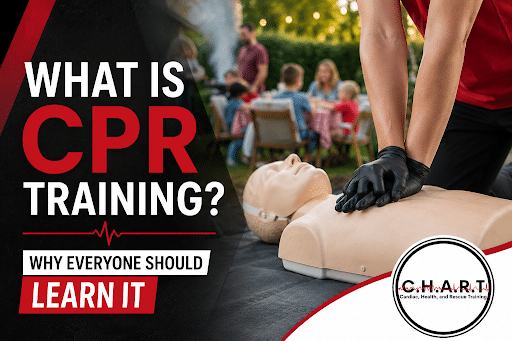
The burgers are almost done.
Kids are racing through the backyard with popsicles melting faster than they can eat them. Someone’s trying to keep the family dog from stealing hot dogs off the picnic table, and Grandpa is halfway through the same fishing story he’s told every Fourth of July for the last twenty years.
Nobody minds.
It’s become part of the tradition.
Then…
He stops talking.
His plate slips from his hands.
Before anyone fully understands what’s happening, he’s on the ground.
The laughter disappears.
Someone screams.
Someone fumbles for a phone to call 911.
Someone else is crying.
Everyone is standing there looking at each other, hoping someone else knows what to do.
Then someone asks the question no family ever wants to hear.
“Does anyone know CPR?”
The truth is, that question isn’t reserved for dramatic scenes on television.
It happens in living rooms.
At birthday parties.
During church potlucks.
In grocery store checkout lines.
At youth soccer games.
In office break rooms.
Life has a funny way of changing without asking permission.
One ordinary moment becomes extraordinary in the space of a heartbeat.
Or sometimes…the absence of one.
That’s why CPR training isn’t just another certification hanging on your wall.
It’s one of the few skills that can completely change what happens during the worst day of someone’s life.
Not because it makes you a hero.
But because it gives you the confidence to help while everyone else is waiting for help to arrive.
So…What Exactly Is CPR Training?
Let’s start with the simple answer.
CPR stands for Cardiopulmonary Resuscitation.
CPR training teaches everyday people how to recognize when someone’s heart has stopped, how to respond quickly, how to perform effective chest compressions, how to use an Automated External Defibrillator (AED), and how to help keep oxygen-rich blood moving through the body until emergency medical services arrive.
Notice something important there?
I said everyday people.
Not doctors.
Not nurses.
Not paramedics.
Parents.
Grandparents.
Teachers.
Coaches.
Coworkers.
Neighbors.
People just like you.
Because when someone experiences sudden cardiac arrest, the first person who can make a difference usually isn’t wearing scrubs.
They’re simply the person standing closest.
The Longest Eight Minutes of Your Life
Here’s something I want you to think about.
Imagine that family barbecue again.
The ambulance has been called.
You know help is coming.
But every second feels like an hour.
You’re kneeling beside someone you love, wishing there was something—anything—you could do.
That feeling of helplessness…
That’s what most people are actually afraid of.
Not CPR.
Helplessness.
Because deep down we all want to believe we’d step up if someone we loved needed us.
The problem is that wanting to help and knowing how to help are two completely different things.
CPR training bridges that gap.
Instead of panic making every decision…
Training gives your hands something to do.
Instead of wondering if you’re making things worse…
You know you’re giving someone their best chance until EMS arrives.
That’s a powerful feeling.
Not because it removes the fear.
It doesn’t.
Emergencies are still scary.
But confidence has a remarkable way of showing up when your hands have practiced what your heart hopes it never has to use.
Before Help Arrives, You Are the Help
One of the biggest misconceptions people have is that calling 911 is the end of their responsibility.
It isn’t.
Calling 911 is the beginning.
Emergency responders do an incredible job getting to people as quickly as possible.
But they can’t teleport.
There are traffic lights.
Road construction.
Weather.
Distance.
Those first few minutes belong to the people already there.
That’s why I created a free resource called The First 20 Minutes: Before Help Arrives.
Because the truth is, most people aren’t frightened by CPR itself.
They’re frightened by not knowing what happens before the ambulance gets there.
That guide walks you through those critical early moments so you can replace uncertainty with preparation.
It’s completely free because I believe every family should understand what those first minutes look like—even if they never have to use the information.
CPR Isn’t Just for Healthcare Workers
I hear this all the time.
“I’m not in healthcare.”
“I’m not responsible for that.”
“Surely someone else would know what to do.”
Maybe.
But maybe not.
Remember Grandpa?
Imagine looking around that backyard.
Who was the nurse?
Who was the firefighter?
Who was the EMT?
Maybe nobody.
And that’s actually normal.
Medical emergencies don’t wait until trained professionals happen to be standing nearby.
They happen wherever life is happening.
That’s why CPR classes are designed for ordinary people.
People who never expected they’d need them.
Parents who want to protect their children.
Adult children caring for aging parents.
Teachers responsible for classrooms.
Coaches responsible for teams.
Business owners responsible for employees.
Neighbors who simply want to be prepared if life asks something difficult of them.
You don’t need a medical background.
You just need a willingness to learn.
CPR Is More Than a Certification—It’s a Life Skill
One thing I tell my students all the time is this:
You don’t learn CPR because you expect something terrible to happen.
You learn CPR because life is beautifully unpredictable.
Learning CPR is a lot like learning to swim.
You hope you never have to rely on it to save a life.
But you’re incredibly grateful you have the skill if that moment ever comes.
The same could be said for wearing a seatbelt.
Buying homeowners insurance.
Knowing how to change a flat tire.
They’re all things we hope we never truly need.
But we’d never want to be without them.
CPR belongs on that same list.
It’s not just another certification.
It’s a life skill.
One that quietly travels with you to every family gathering, every road trip, every soccer game, every church picnic, every office meeting, and every ordinary Tuesday.
Want to Go Deeper?
If you’ve ever wondered why I believe CPR belongs in the same category as learning to swim, wearing a seatbelt, or knowing how to change a flat tire, I explore that idea in more depth here:
👉 Read next: No Pulse. No Breath. Just You. What Happens Next?
It’s one of my favorite articles because it shifts the conversation from earning a certification to becoming the person your family can count on when every second matters.
Why Every Workplace Should Invest in CPR Training
Now let’s leave the backyard for a moment.
Picture a completely different scene.
It’s Tuesday morning.
Coffee is brewing in the break room. Someone’s talking about the weekend. Another coworker is rushing to finish a project before lunch.
Then someone collapses.
Everything changes.
The same question echoes through the office.
“Does anyone know CPR?”
Emergencies don’t care whether you’re at home or at work.
For many of us, we spend more waking hours with our coworkers than we do with our own families. Yet many businesses assume serious medical emergencies happen somewhere else.
Until they happen in their office.
Their warehouse.
Their daycare.
Their church.
Their manufacturing facility.
CPR training isn’t just about checking a compliance box.
It’s about creating a workplace where people know how to take care of one another.
Employees become more confident.
Managers feel more prepared.
Entire teams become stronger because everyone understands that safety isn’t just about preventing accidents—it’s about knowing how to respond when life takes an unexpected turn.
Because someday the person needing help could be the coworker sitting right beside you.
The Biggest Obstacle Isn’t Learning CPR
It’s believing you can actually do it.
I’ve taught enough CPR classes to know that nearly everyone walks in carrying the same fear.
“What if I freeze?”
“What if I forget?”
“What if I hurt someone?”
Those are honest questions.
And they’re completely normal.
But here’s something I’ve learned after years of teaching people from every walk of life.
Confidence doesn’t come from reading an article.
It doesn’t come from watching a video.
It doesn’t even come from memorizing the steps.
Confidence comes from doing.
I’ve watched students walk into class convinced they could never perform CPR.
Then they place their hands on the manikin.
They practice.
They laugh when they lose the rhythm.
They try again.
Something begins to change.
By the end of class, they’re standing a little taller—not because they’re fearless, but because they’ve discovered they can do this.
That’s one of my favorite moments as an instructor.
Watching uncertainty turn into confidence.
Watching people realize they’re far more capable than they believed.
CPR Training Has Changed with Real Life
Let’s be honest.
Life is busy.
Between work, kids, appointments, grocery shopping, and trying to remember whether the laundry actually made it into the dryer (or is still sitting in the washer from yesterday—we’ve all been there), adding one more thing to the calendar can feel impossible.
That’s why CPR training doesn’t have to be complicated.
At CHART, we’ve made it flexible.
You complete the cognitive learning portion online, whenever it fits your schedule.
No rushing across town after work.
No rearranging your entire week.
Just learn at your own pace.
Then comes the hands-on skills session.
If you’re close to us, we’ll complete that portion in person.
If you live farther away, we can complete your skills assessment over Zoom using a manikin delivered right to your home.
You still receive the coaching.
You still practice the skills.
You still build the confidence.
The only thing that changes is how convenient we’ve made it for you.
Because learning CPR should fit into your life—not become another obstacle.
Preparedness Doesn’t End When Class Is Over
One of the things I love most about teaching is watching people realize they’re more capable than they thought.
But earning your CPR certification isn’t the end of the journey.
It’s really the beginning.
Emergency preparedness isn’t something you learn once and then tuck away in a drawer for two years until renewal time.
The more you revisit these skills, the more naturally you’ll respond if you ever need them.
That’s why I continue sharing practical emergency preparedness tips, CPR education, common myths, and real-life stories long after my students leave class.
If you’d like to continue learning, here are two places I think you’ll enjoy.
The CHART Blog is full of practical articles written for everyday people—not healthcare professionals. Whether you’re curious about first aid, emergency preparedness, CPR myths, or simply want to become more confident protecting the people you love, there’s always something new to learn.
And if you’re someone who enjoys short, practical videos, I’d love to have you join me on YouTube at @chart911.
Every week I share emergency preparedness tips, answer common CPR questions, discuss real-life emergency situations, and help make lifesaving skills feel approachable instead of overwhelming.
Think of it as continuing your education—one encouraging video at a time.
Learning CPR Is Really About Peace of Mind
Remember Grandpa?
I hope he never needs CPR.
I hope your family never experiences that terrifying moment.
I hope every family gathering ends with one more fishing story, sticky popsicle fingers, and someone accidentally burning the burgers.
But hope isn’t a plan.
Preparation is.
None of us gets to decide when emergencies arrive.
What we do get to decide is whether we’re ready when they do.
That’s what CPR training really gives people.
Not just knowledge.
Peace of mind.
The quiet confidence that says,
“If something happens…I know where to start.”
And sometimes that’s the greatest gift we can give the people we love.
Frequently Asked Questions
What is CPR training?
CPR training teaches everyday people how to recognize cardiac arrest, perform effective chest compressions, use an AED, respond to choking emergencies, and provide lifesaving care until emergency responders arrive.
Is CPR training difficult?
Not at all. CPR classes are designed for people with no medical background. Through hands-on practice and supportive instruction, you’ll leave feeling far more confident than when you arrived.
Can I complete CPR training online?
Yes. At CHART, the cognitive learning portion is completed online. You’ll then finish your hands-on skills either in person if you’re local or remotely over Zoom using a manikin shipped directly to your home.
Who should learn CPR?
Everyone.
Parents.
Grandparents.
Teachers.
Coaches.
Business owners.
Employees.
Church volunteers.
Anyone who wants to be prepared before an emergency happens.
Your Next Steps
If you’ve made it this far, something probably resonated with you.
Maybe you pictured Grandpa.
Maybe you thought about your children.
Maybe your parents.
Maybe your coworkers.
Or maybe you simply realized you’ve been saying, “I really should learn CPR someday…” for a lot longer than you’d like to admit.
Don’t let “someday” become “I wish I had.”
If you’re just beginning your emergency preparedness journey, here are a few places I’d recommend starting.
❤️ Download my free guide, The First 20 Minutes: Before Help Arrives.
It will help you understand what happens during those critical moments before EMS arrives and help replace uncertainty with preparation.
📚 Keep learning through the CHART Blog.
Emergency preparedness goes far beyond CPR, and you’ll find articles that make complex topics practical, approachable, and relevant to everyday life.
🎥 Join me on YouTube at @chart911.
Every week I share free emergency preparedness education designed to help you feel more confident before an emergency ever happens.
And when you’re ready…
Let’s talk.
Whether you’re looking for CPR training for yourself, your family, your workplace, or your organization, I’d be happy to help you choose the class that’s the best fit.
You’ll complete the learning portion online, then we’ll finish your hands-on skills either in person or remotely over Zoom with a manikin delivered to your home.
If you’re not sure where to begin, schedule a quick call with me.
No pressure.
No sales pitch.
Just a conversation about helping you become prepared.
The Person Who Steps Forward
I hope that family barbecue never changes.
I hope Grandpa finishes every fishing story.
I hope every holiday ends with laughter, full plates, and one more family photo.
But if life ever changes in an instant…
If someone you love needs help before the ambulance arrives…
I hope you’re the person who quietly kneels beside them and says,
“I’ve got this.”
Not because you’re fearless.
Not because you’re a doctor.
But because you cared enough to prepare before the moment ever arrived.
Because CPR training isn’t really about learning how to save a life.
It’s about making sure that when someone else’s world stops…
Yours doesn’t.