
You know that moment when someone asks, “Wait… do I need BLS or ACLS?” and suddenly the room gets oddly quiet?
It’s usually followed by someone confidently guessing, someone else saying, “I think ACLS is the advanced CPR one?” and at least one exhausted healthcare worker staring into the middle distance while clutching coffee like it’s emotional support equipment.
Fair. The certifications sound similar. Both involve lifesaving skills. Both come with acronyms that healthcare somehow expects everyone to magically understand by osmosis. But the difference between BLS and ACLS actually matters — especially if you’re renewing certifications, starting a healthcare role, or trying not to accidentally sign up for the wrong class at 11:47 PM after a twelve-hour shift.
Here’s the simple version:
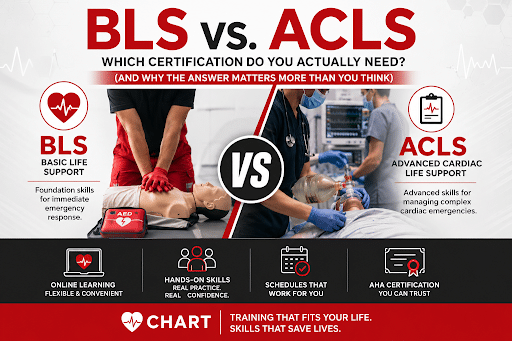
BLS (Basic Life Support) teaches foundational emergency response skills like CPR, AED use, and helping someone during cardiac arrest or choking.
ACLS (Advanced Cardiac Life Support) builds on BLS and is designed for healthcare providers managing more complex cardiac emergencies, including medication protocols, airway management, rhythm interpretation, and team-based resuscitation.
One is your foundation. The other is your next-level emergency response training.
And if your brain just unclenched a little? Same.
What Is BLS Certification?
American Heart Association BLS Overview
BLS certification is typically the starting point for healthcare providers. It focuses on the immediate response needed during life-threatening emergencies before advanced medical care arrives or escalates.
BLS training usually covers:
- High-quality CPR for adults, children, and infants
- AED (Automated External Defibrillator) use
- Relief of choking
- Team-based resuscitation basics
- Recognizing cardiac arrest quickly
- Effective chest compressions and rescue breathing
This course is commonly required for:
- Nurses
- CNAs
- Medical assistants
- Dental professionals
- EMTs
- Physical therapists
- Healthcare students
- Childcare providers
- First responders
In other words, BLS is the “every healthcare provider should know this” certification. Kind of like hand hygiene… but with significantly higher stakes.
At CHART, most students complete the learning portion online first, then meet in person for practical skills testing. Which honestly works beautifully for busy healthcare schedules because trying to coordinate traditional classroom hours around rotating shifts is basically a Sudoku puzzle designed by chaos itself.
What Is ACLS Certification?
American Heart Association ACLS Overview
ACLS certification is designed for healthcare professionals who participate in managing cardiopulmonary emergencies and other critical cardiovascular situations.
This training goes beyond basic CPR and focuses on advanced interventions during cardiac emergencies.
ACLS training includes:
- Advanced airway management
- ECG/rhythm interpretation
- Pharmacology during cardiac events
- Managing stroke and acute coronary syndromes
- Team dynamics during resuscitation
- Megacode scenarios
- Post-cardiac arrest care
Healthcare providers who often need ACLS include:
- Physicians
- RNs working in critical care or emergency settings
- Paramedics
- Respiratory therapists
- ICU staff
- ER personnel
Here’s the easiest way to think about it:
BLS teaches you how to respond to an emergency.
ACLS teaches you how to lead through one.
That distinction matters.
So… Which One Do You Need?
This is usually determined by your employer, licensing requirements, or clinical role.
But here’s a practical breakdown:
You likely need BLS if:
- You provide direct patient care
- You work in healthcare support roles
- You’re entering nursing or allied health programs
- Your workplace requires CPR certification
You likely need ACLS if:
- You manage cardiac emergencies
- You work in emergency medicine or critical care
- You administer cardiac medications during emergencies
- Your role involves advanced airway or rhythm management
And yes — most providers who need ACLS also need current BLS certification first.
Think of BLS like learning to drive the car safely.
ACLS is learning how to handle the vehicle during a blizzard while someone’s yelling medical terminology and the GPS has emotionally given up.
Different skill level. Same important mission.
Why Hands-On Skills Still Matter (Even with Online Learning)
Here’s something we see all the time at CHART:
People finish the online portion feeling pretty confident… until it’s time for the practical skills session.
Not because they’re incapable. Because lifesaving skills are physical skills.
Chest compressions have a rhythm and depth you can’t fully learn from slides. Airway management takes practice. Team response requires communication under pressure. Your hands need repetitions, not just information.
That’s why CHART combines online coursework with in-person skills testing and hands-on practice.
It gives healthcare providers flexibility without skipping the part that actually builds muscle memory.
And honestly? That balance tends to lower stress for students too. You can learn the academic portion on your own schedule, then come together for focused, practical application without spending an entire weekend trapped in fluorescent lighting questioning your life choices.
Why Healthcare Providers Choose CHART
At CHART, training is designed around real healthcare life — not fantasy schedules created by people who’ve apparently never worked a double shift.
Based out of Iron Mountain, CHART provides:
- BLS certification and renewals
- ACLS certification and renewals
- Flexible online learning options
- In-person practical skills sessions
- Mobile training for groups and facilities
That last part matters more than people realize.
If your clinic, office, healthcare team, or organization needs certification training, CHART can travel to you. Which means less disruption for your staff and significantly fewer scheduling headaches.
Because coordinating healthcare professionals into one room at the same time is honestly a little like herding caffeinated squirrels with pagers.
Possible? Yes.
Easy? Not traditionally.
The Real Goal Isn’t Just “Getting Certified”
The card matters. Of course it does.
But the real goal is confidence under pressure.
It’s knowing what to do when someone stops breathing. It’s recognizing rhythms faster. It’s responding instead of freezing. It’s having the kind of preparation that quietly changes how you show up in emergencies.
Whether you need BLS, ACLS, or renewals for both, the right training should leave you feeling capable — not overwhelmed.
That’s the difference good instruction makes.
If you’re due for certification or renewal and want flexible training that works with real-world healthcare schedules, CHART can help. You can learn more or schedule training directly through CHART, contact us here.
Frequently Asked Questions
Can you take ACLS without BLS?
Most ACLS courses require current BLS certification because ACLS builds on foundational CPR and emergency response skills.
How long are BLS and ACLS certifications valid?
Both BLS and ACLS certifications through the American Heart Association are generally valid for two years.
Is online BLS or ACLS accepted?
Many healthcare employers accept blended learning formats that combine online coursework with in-person skills testing. Always confirm your employer’s specific requirements.
How long does BLS or ACLS training take?
The online learning portion is self-paced, while hands-on skills sessions are typically much shorter and more focused than traditional classroom-only courses.
Does CHART travel for group training?
Yes. CHART offers mobile training options for healthcare facilities, clinics, offices, and organizations needing group certification or renewal sessions.